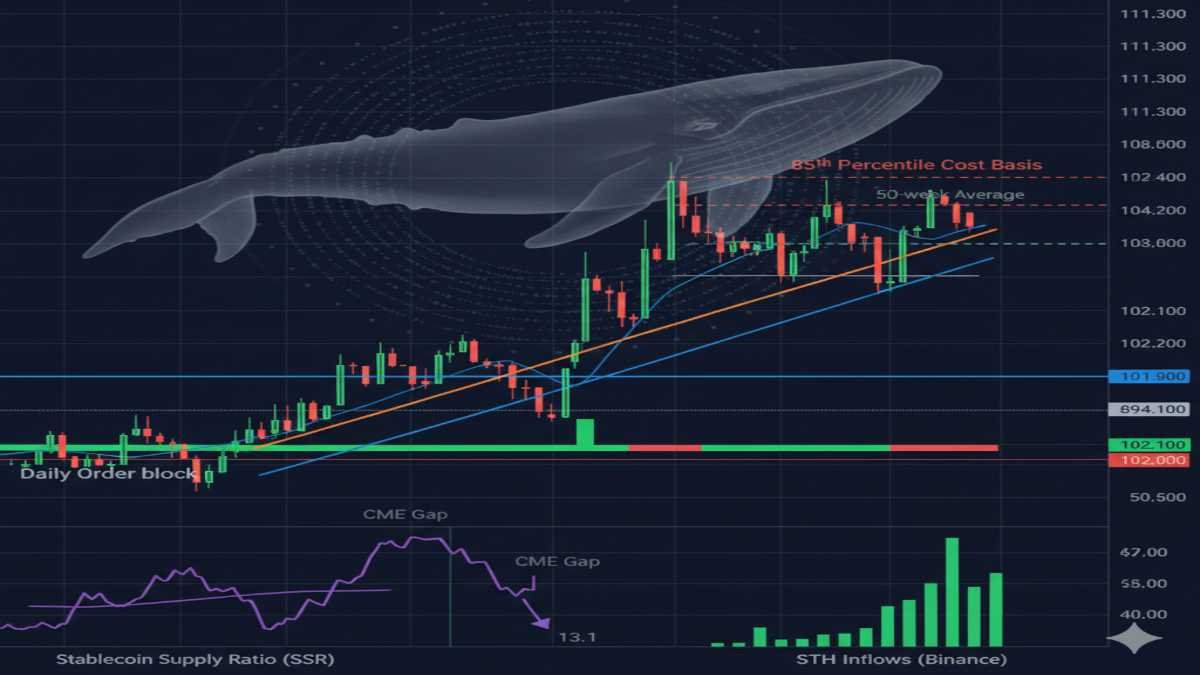
Bitcoin (BTC) recently executed a classic double bottom pattern over the weekend, a bullish technical formation that helped the cryptocurrency secure a strong weekly close above its 50-week moving average. This rebound was notably supported by the daily order block situated between $98,100 and $102,000, a zone BTC repeatedly tested before its latest upswing.
Following a decisive bullish break on its four-hour chart, Bitcoin is now confronting resistance near the $111,300 mark. While short-term momentum suggests a potential test of this level, underlying on-chain data indicates that this advance may not be straightforward.
According to Glassnode, Bitcoin’s recent recovery originated from the 75th percentile cost basis, around $100,000. The next significant barrier for BTC is the 85th percentile cost basis, approximately $108,500. This metric, which maps the cost distribution of BTC across the market by measuring where most investors acquired their holdings, has historically acted as a resistance point during recovery phases.
Further complicating the immediate outlook, Cointelegraph has highlighted a potential liquidity grab above $115,000, aligning with a key daily resistance level. This comes as long-side liquidity near $100,000 appears to be exhausted. Additionally, a CME gap between $103,100 and $104,000 remains a short-term risk. Such gaps, formed by Bitcoin’s price movements over the weekend on the Chicago Mercantile Exchange, frequently get “filled” as traders retrace to these levels, suggesting a possible brief pullback before any sustained upward movement. Given thinning liquidity and participation, a retest of the 102,500 range, targeting the weekend’s one-hour and four-hour order blocks, could precede a more decisive move higher.
Stablecoin Strength and Short-Term Holder Behavior
The dynamics of stablecoins could significantly influence Bitcoin’s short-term trajectory. CryptoQuant data reveals a plunge in the Stablecoin Supply Ratio (SSR) to 13.1, a significant drop from above 18 earlier this year and one of the lowest levels recorded in 2025. This decline signifies an increase in stablecoin reserves relative to Bitcoin’s market capitalization, suggesting a substantial amount of off-chain liquidity is accumulating, awaiting a clear market signal. The SSR’s fall from 15 to 13 over the past month, while BTC hovered near $105,000, further supports the notion that buyers are holding back, awaiting confirmation before deploying capital.
Conversely, crypto analyst Darkfost has observed a 40% surge in short-term holder (STH) inflows to Binance since September, rising from 5,000 BTC to 8,700 BTC. With the realized price for these STHs around $112,000, many are currently “underwater” and highly susceptible to short-term volatility. Selling pressure from this cohort has historically preceded mid-cycle shakeouts before broader bullish continuations, introducing an element of short-term instability to the market.


